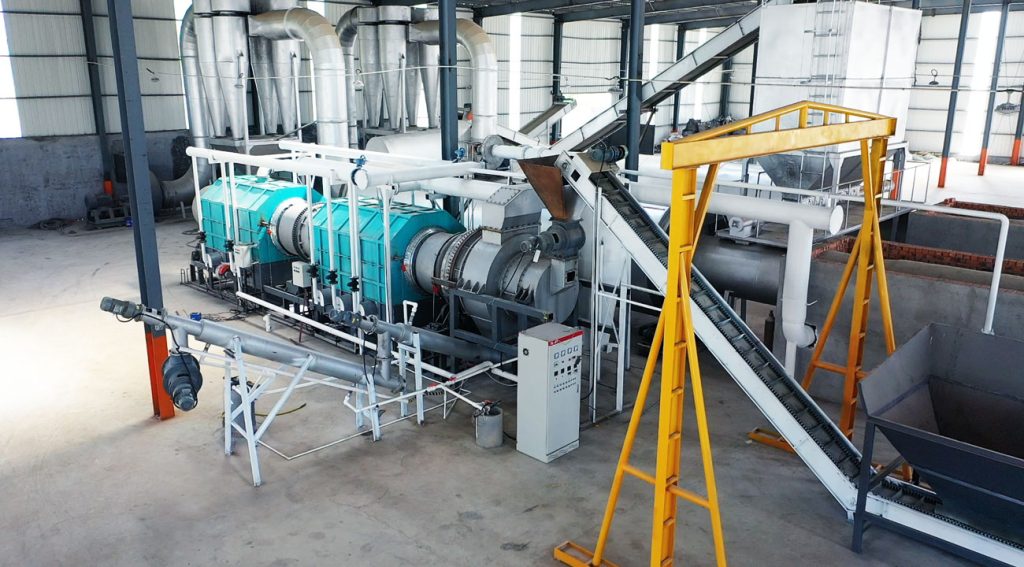
Carbonization production lines are essential systems for converting biomass, agricultural residues,
or industrial waste into charcoal or biochar. Safe and stable operation is critical not only for
protecting personnel and equipment, but also for maintaining product quality and long-term profitability.
In modern industrial applications, the continuous carbonization furnace is widely adopted
due to its high efficiency, stable output, and suitability for large-scale production.
However, safe operation requires strict management and proper maintenance.
1. Key Safety Risks in Carbonization Production
Fire and Explosion Hazards
Carbonization involves high-temperature thermal decomposition under oxygen-limited conditions.
If air leakage, improper feeding, or temperature loss of control occurs, fire or explosion risks may arise.
- Ensure airtight operation of the continuous carbonization furnace
- Install temperature, pressure, and oxygen monitoring systems
- Maintain stable feeding and moisture control
Toxic Gas Exposure
Carbonization gas may contain carbon monoxide and other harmful compounds.
Proper gas collection and treatment systems are essential.
- Use sealed reactors and gas pipelines
- Install gas detection and alarm systems
- Provide appropriate personal protective equipment (PPE)
Mechanical Safety Risks
Feeding screws, conveyors, and discharge systems can cause mechanical injuries if not properly protected.
- Install safety guards and interlocks
- Implement lockout and tagout procedures during maintenance
- Provide operator safety training
2. Operational Best Practices
Feedstock Management
Stable operation starts with proper feedstock preparation:
- Remove stones, metals, and foreign materials
- Control particle size for smooth feeding
- Pre-dry high-moisture materials when necessary
Temperature and Residence Time Control
Precise thermal control is essential for consistent carbon quality.
The continuous carbonization furnace should operate within designed temperature ranges.
- Calibrate temperature sensors regularly
- Avoid sudden temperature fluctuations
- Maintain stable residence time
Process Monitoring
Automated monitoring improves both safety and efficiency:
- Real-time monitoring of temperature and pressure
- Gas composition analysis
- Alarm systems for abnormal conditions
3. Maintenance Guidelines
Daily Inspections
- Check feeding and discharge systems for blockages
- Inspect seals and joints for air leakage
- Observe abnormal noise or vibration
Periodic Maintenance
- Inspect furnace lining and refractory materials
- Clean gas treatment and condensation systems
- Lubricate moving parts
- Test safety valves and sensors
Preventive Maintenance Strategy
Preventive maintenance reduces downtime and extends equipment lifespan.
- Establish maintenance schedules based on operating hours
- Record inspection and repair logs
- Train operators to identify early warning signs
4. Emergency Response Procedures
In case of emergency:
- Immediately shut down the continuous carbonization furnace
- Evacuate personnel from hazardous areas
- Activate ventilation or fire suppression systems
- Conduct incident analysis before restart
5. Training and Documentation
A safe carbonization production line depends on skilled operators and clear documentation.
- Develop standard operating procedures (SOPs)
- Conduct regular safety training and drills
- Maintain detailed operation and maintenance records
Conclusion
Safe operation and maintenance are the foundation of reliable carbonization production.
With proper risk control, process monitoring, and preventive maintenance,
a continuous carbonization furnace can operate efficiently, safely, and sustainably
over the long term.
A well-managed carbonization line not only protects people and equipment,
but also ensures consistent product quality and strong economic performance.
Leave a Reply