In the push toward renewable energy and sustainable materials, biomass carbonization machines have emerged as a cornerstone technology. These systems transform organic waste—such as agricultural residues, sawdust, coconut shells, or rice husks—into valuable carbon-rich products like biochar, charcoal, or activated carbon. But behind the blackened output lies a fascinating world of molecular transformations, where heat and chemistry work hand in hand to reshape the very structure of matter.
What Is Biomass Carbonization?
At its core, carbonization is the thermal decomposition of organic material in a low-oxygen environment. Unlike open burning, which allows full combustion and converts biomass mainly into CO₂ and ash, carbonization restricts oxygen so that volatile compounds are released without complete oxidation. The result is a solid carbon structure that retains much of the original biomass’s skeleton—yet has undergone dramatic molecular change.
The Molecular Phases of Carbonization
The molecular decomposition process inside a biomass carbonization machine can be divided into four main stages: drying, pyrolysis, carbonization, and solid stabilization. Each step is driven by temperature, time, and the chemical makeup of the feedstock.
1. Drying (Below 200°C)
The process begins gently. Biomass typically contains 10–50% moisture, which must evaporate before true decomposition begins. Water molecules are released as vapor, breaking weak hydrogen bonds that tie them to cellulose and hemicellulose structures. Though no major molecular rearrangement happens yet, this step sets the stage for the more intense reactions to come.
2. Pyrolysis (200–400°C)
As the temperature climbs above 200°C, pyrolysis begins—the heart of the transformation. Long polymeric chains of cellulose, hemicellulose, and lignin start to crack apart.
- Cellulose, a linear polysaccharide, depolymerizes into smaller molecules like levoglucosan and other anhydrosugars.
- Hemicellulose, more thermally unstable, decomposes earlier, releasing carbon dioxide, acetic acid, and tars.
- Lignin, the most complex of the three, breaks down more slowly, yielding phenolic compounds and aromatic hydrocarbons.
During this stage, volatile organic compounds (VOCs) and gases—such as CO, CH₄, and H₂—are released, while the remaining solid residue becomes richer in carbon. The process is endothermic, absorbing heat as bonds break and molecules rearrange.
3. Carbonization (400–700°C)
Now, the real alchemy occurs. As temperatures approach 500°C and above, secondary reactions dominate. Tar vapors and remaining volatiles undergo dehydrogenation, condensation, and polymerization, leading to the formation of stable aromatic carbon structures.
This is where the material truly becomes charcoal. Hydrogen and oxygen atoms are progressively expelled as water (H₂O), carbon monoxide (CO), and carbon dioxide (CO₂). What remains is a porous, carbon-dense lattice made of polycyclic aromatic carbon rings—similar to those found in graphite.
At the molecular level, this phase represents a transformation from a mixed organic polymer network to a quasi-crystalline carbon domain. The ratio of carbon to hydrogen (C/H) and carbon to oxygen (C/O) dramatically increases, signifying a shift toward greater chemical stability and energy density.
4. Solid Stabilization and Cooling
Once the carbon skeleton has formed, the machine gradually reduces temperature to prevent re-oxidation. As it cools, reactive sites on the char’s surface may attract trace oxygen, forming functional groups such as hydroxyl (-OH), carbonyl (C=O), and carboxyl (-COOH). These surface features give biochar its ability to adsorb nutrients, heavy metals, and pollutants—making it not only an energy source but also a valuable tool for soil enhancement and water purification.
The Role of Controlled Environment
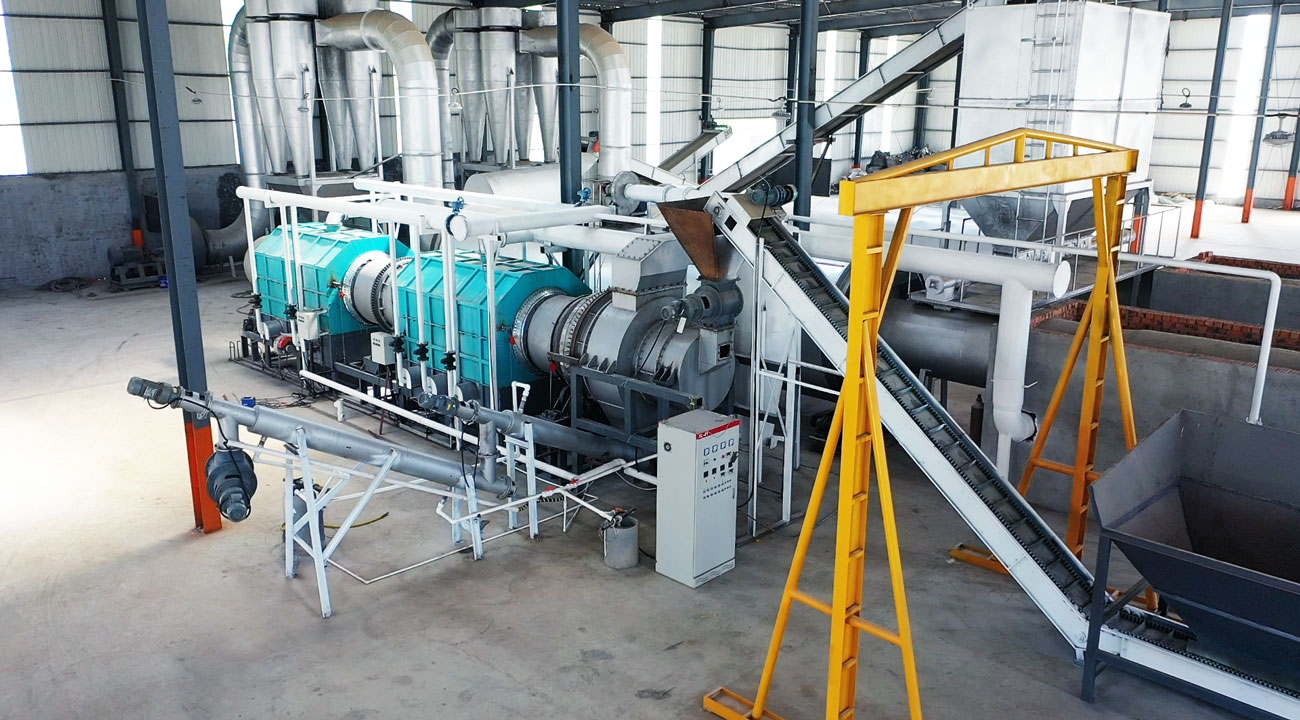
A biomass carbonization machine ensures that these reactions unfold in a precisely controlled environment. By regulating temperature, residence time, and oxygen input, operators can tune the process to produce specific outcomes—whether a highly porous biochar for agriculture or a dense charcoal for fuel. The machine’s airtight reactor prevents external oxygen from triggering combustion, allowing decomposition to proceed purely through thermal chemistry rather than flame oxidation.
From Molecules to Meaning
What makes biomass carbonization so remarkable is not just its efficiency, but its molecular elegance. It demonstrates how natural polymers—once part of living tissue—can be transformed into stable carbon structures that last for centuries. The process is, in essence, a modern echo of what nature has done for millions of years: converting organic matter into carbon through slow geological heating, as in the formation of coal. The carbonization machine simply accelerates that timeline to a matter of hours.
Conclusion
The molecular decomposition within a biomass carbonization machine is a story of transformation—from living carbon to elemental carbon, from instability to endurance. It is a dance of energy, atoms, and time, yielding materials that help close the carbon cycle sustainably. By mastering the science of molecular breakdown, we not only unlock cleaner fuels and smarter materials but also step closer to a circular, low-carbon future.
Leave a Reply