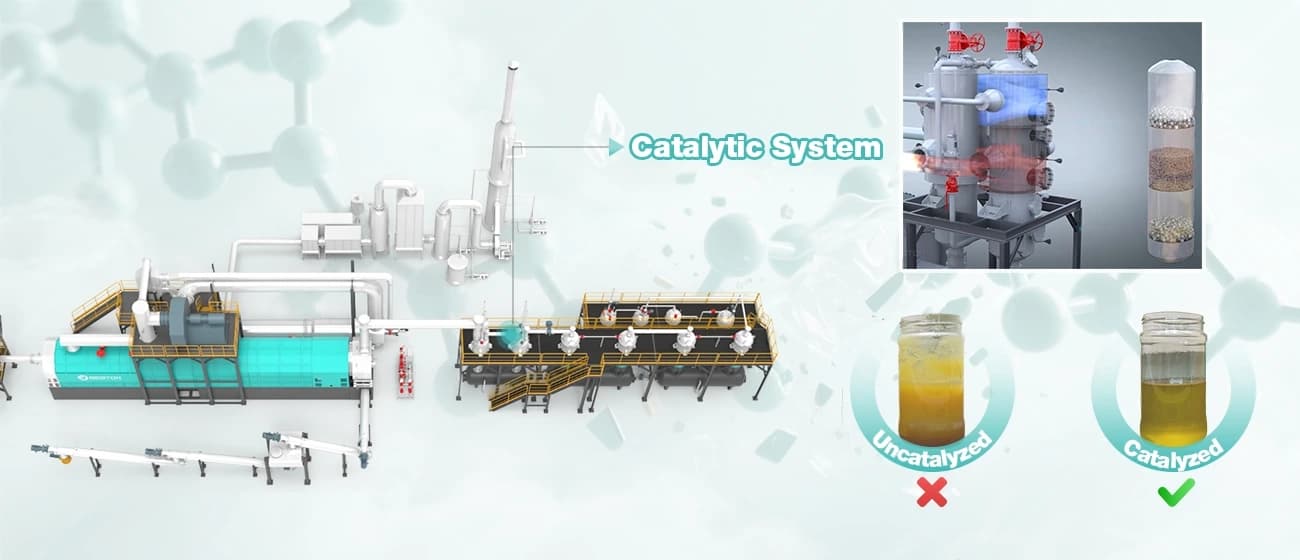
Plastic pyrolysis alone can turn waste into fuel, but without catalysts, the process is messy: it produces a mix of short and long hydrocarbon chains, unwanted byproducts like heavy oils, and requires high temperatures. Catalysts change this game—at the molecular level, they act as “molecular matchmakers,” guiding how plastic polymers break apart and reassemble into valuable fuels. Let’s dive into the atomic-scale details that make catalytic plastic pyrolysis a game-changer for waste management and energy.
The Molecular Problem: Why Plain Pyrolysis Falls Short
To understand catalysts’ role, start with plastic’s molecular structure. Most plastics (like polyethylene, PE) are long chains of repeating carbon-hydrogen (C-H) units—think of a string of beads, where each bead is a -CH₂- group. In non-catalytic pyrolysis, high heat (400–600°C) randomly snaps these long chains into shorter fragments. But this randomness is a flaw: some fragments are too short (like methane, CH₄, a low-value gas), others too long (heavy waxes that clog equipment), and few match the molecular length of diesel or gasoline (which need 8–16 carbon atoms per molecule).
Worse, plastics like polypropylene (PP) have branched molecular structures—extra -CH₃ groups sticking off the main chain. Plain pyrolysis often leaves these branches intact, creating irregular hydrocarbons that don’t burn cleanly in engines. Catalysts fix this by controlling where and how molecular bonds break, and even rearranging atoms to form more useful structures.
Catalysts at Work: Molecular Scissors and Architects
Catalysts for plastic pyrolysis process fall into two main categories, each acting differently at the molecular level: zeolites and metal oxides.
Zeolites are porous minerals with a honeycomb-like structure—their tiny pores (just 0.5–1 nanometers wide) act as “molecular sieves.” When plastic chains enter these pores, the zeolite’s acidic sites (places with extra positive charge) target the C-C bonds in the polymer backbone. Instead of random breaks, the zeolite snips the chains at specific points, ensuring most fragments are 8–12 carbon atoms long—perfect for gasoline. It also fixes branching: the acidic sites strip off extra -CH₃ groups from PP chains, turning branched molecules into straight-chain hydrocarbons that burn efficiently.
Metal oxides (like ZnO or Al₂O₃) work differently—they act as “hydrogen shuttles.” Plastic chains have lots of C-H bonds, but during pyrolysis, some chains lose hydrogen atoms, forming unstable double bonds (C=C). Metal oxides donate hydrogen atoms to these unstable molecules, turning them into stable alkanes (the main component of diesel). For example, a fragmented PE chain with a C=C bond might react with ZnO: the oxide gives up a hydrogen atom, turning the double bond into a single bond (C-C) and creating a useful diesel molecule. Metal oxides also reduce unwanted byproducts: they trap oxygen-containing molecules (like ketones or acids) that form from plastic additives, preventing them from contaminating the fuel.
Beyond Breaking Bonds: Tuning Catalysts for Better Fuels
The real power of catalysts lies in their tunability—scientists can tweak their molecular structure to produce specific fuels. For instance, modifying a zeolite’s pore size changes the end product: smaller pores (0.5 nm) favor gasoline (8–10 carbon atoms), while larger pores (0.7 nm) produce more diesel (12–16 carbon atoms). Adding tiny metal particles (like nickel or palladium) to zeolites enhances their ability to remove branches, making the fuel even cleaner.
This tunability solves a key problem: different plastics have different molecular structures, so one catalyst can’t handle all. A zeolite optimized for PE (straight chains) might struggle with PVC (which has chlorine atoms). But by combining zeolites with chlorine-trapping metals (like copper), scientists can create catalysts that break down PVC’s C-Cl bonds first, releasing chlorine as a harmless salt before processing the hydrocarbon chain.
The Future: Molecular Engineering for Sustainability
Catalytic plastic pyrolysis isn’t perfect yet. Over time, catalysts get “poisoned”—carbon deposits (coke) build up on their surface, blocking pores and slowing reactions. But researchers are fighting back: they’re designing catalysts with more stable molecular structures, like core-shell metals (a metal core wrapped in a protective oxide layer) that resist coking.
At its heart, catalytic plastic pyrolysis is a molecular dance—catalysts guide plastic’s carbon and hydrogen atoms to rearrange into fuels, turning waste into value. As we refine these molecular tools, we’re not just improving a waste-to-energy process—we’re inching closer to a future where plastic pollution and energy scarcity are solved with the same atomic-level ingenuity.
Leave a Reply