Plastic waste has become one of the most urgent environmental challenges of our time. Traditional recycling methods can only handle a small portion of the millions of tons of plastic produced each year. The rest often ends up in landfills or oceans, where it takes centuries to degrade.
To tackle this crisis, engineers and environmental innovators are turning to a breakthrough technology: the plastic pyrolysis machine, especially those equipped with catalytic pyrolysis systems.
What Is a Plastic Pyrolysis Machine?
A plastic pyrolysis machine is a system designed to convert waste plastics — such as PE, PP, PS, ABS, and even certain PVC types — into valuable fuel oil, carbon black, and combustible gas through thermal decomposition in the absence of oxygen.
The process takes place at high temperatures (around 350°C–500°C), breaking long-chain polymer molecules into shorter hydrocarbons that can be reused as energy or raw materials.
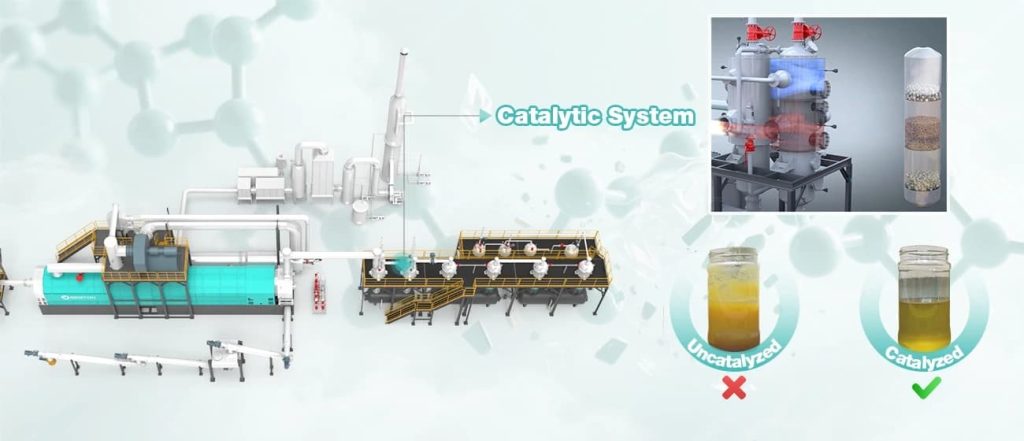
When catalysts are added, this process becomes catalytic pyrolysis — faster, more efficient, and more selective in producing high-quality oil.
How Catalytic Pyrolysis Works
Catalytic pyrolysis combines heat and chemical catalysis to optimize the breakdown of plastic polymers.
Step 1: Feeding and Pre-Treatment
Waste plastic is shredded, cleaned, and dried to remove moisture and contaminants.
Step 2: Pyrolysis Reaction
Inside a sealed reactor, the plastic is heated under oxygen-free conditions. With the help of a solid catalyst (such as zeolite or alumina-based catalysts), long polymer chains are cracked into shorter hydrocarbons.
Step 3: Vapor Condensation
The resulting hydrocarbon vapors are cooled in condensers to form liquid pyrolysis oil, while non-condensable gases are recycled as fuel for heating.
Step 4: Residue Collection
A small amount of carbon black and solid residues are collected and can be reused for industrial or construction purposes.
Why Use Catalysts?
Catalysts play a crucial role in improving both the quality and efficiency of pyrolysis.
- Lower Reaction Temperature – Catalysts allow cracking reactions to occur at lower temperatures, saving energy and extending equipment life.
- Faster Reaction Speed – They accelerate polymer breakdown, increasing overall output.
- Better Oil Quality – Catalytic pyrolysis produces lighter hydrocarbons, closer in composition to commercial diesel or gasoline.
- Reduced Char Formation – Catalysts minimize solid residues and unwanted by-products.
Environmental and Economic Benefits
- Plastic Waste Reduction – Converts non-recyclable plastics into useful resources, preventing landfill overflow.
- Renewable Energy Source – The produced oil can be refined into diesel, generator fuel, or chemical feedstock.
- Low Emission Technology – Modern catalytic systems include gas purification and flue gas recovery units, ensuring compliance with global environmental standards.
- High Profit Potential – Turning waste into oil reduces raw material costs and creates new revenue streams for recycling businesses.
Future Outlook: Toward a Circular Plastic Economy
The catalytic plastic pyrolysis machine is a key technology driving the shift toward a circular plastic economy — where waste plastics are no longer discarded but continuously reused as raw materials for new energy and products.
With continuous improvements in catalyst design, automation, and emission control, pyrolysis technology is becoming cleaner, safer, and more profitable than ever before.
In the near future, catalytic pyrolysis could transform how the world views plastic — not as waste, but as a renewable resource.
Leave a Reply