As the global demand for sustainable materials continues to rise, bamboo — often called “green steel” — is gaining attention not only as a construction material but also as a renewable source for charcoal production.
At the heart of this eco-friendly transformation is the bamboo charcoal making machine, a technology that turns bamboo waste into high-value carbon materials with wide industrial and environmental applications.
What Is a Bamboo Charcoal Machine?
A bamboo charcoal machine (or bamboo carbonization furnace) uses high-temperature pyrolysis to convert bamboo into charcoal, tar, wood vinegar, and combustible gas.
Unlike traditional charcoal-making methods, which are inefficient and polluting, modern bamboo charcoal machines operate in a fully sealed, oxygen-free environment — ensuring clean, energy-saving, and continuous production.
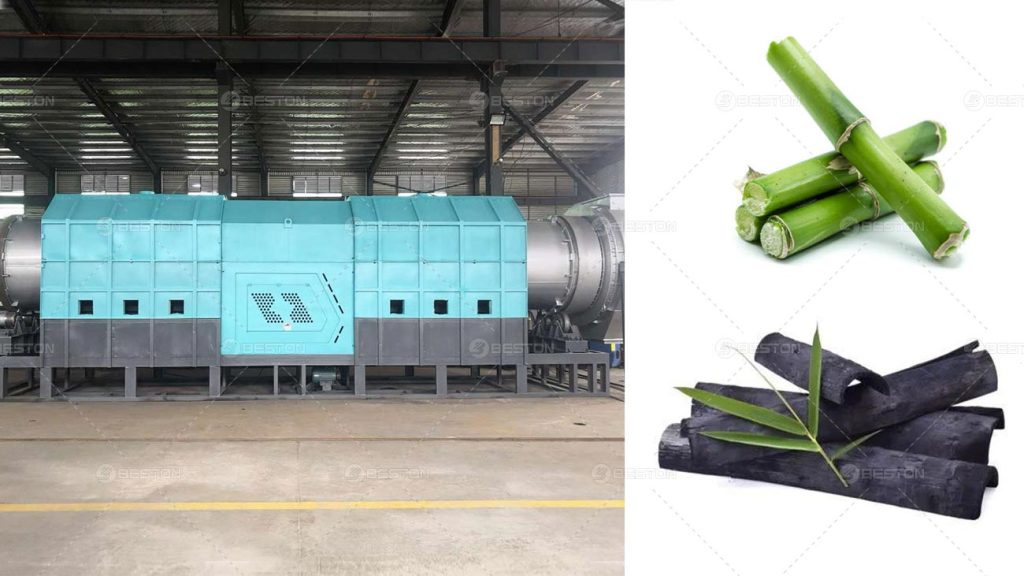
Why Bamboo?
Bamboo is one of the fastest-growing plants on Earth — some species can grow up to a meter a day. This makes it a highly renewable resource, ideal for sustainable charcoal production.
Key reasons bamboo is perfect for carbonization:
- Rapid regeneration – Bamboo can be harvested every 3–5 years without replanting.
- High carbon content – Produces dense, high-quality charcoal with strong adsorption ability.
- Low environmental impact – Grows without pesticides and helps absorb CO₂ during growth.
The Process: From Raw Bamboo to Activated Charcoal
- Crushing and Drying – Bamboo is cut, crushed, and dried to remove excess moisture.
- Carbonization – The bamboo is heated in an oxygen-free chamber between 400°C–600°C.
- Cooling and Collection – The resulting bamboo charcoal is cooled and collected safely.
- By-product Utilization – Wood vinegar and tar are separated and can be reused or sold.
Through activation processing, bamboo charcoal can also become activated carbon, widely used for air purification, water filtration, cosmetics, and industrial refining.
Environmental and Economic Benefits
- Zero Waste & Low Emissions – Advanced purification systems recycle combustible gas for heating, achieving near-zero pollution.
- High-Value Products – Bamboo charcoal and bamboo activated carbon sell at premium prices due to their purity and versatility.
- Energy Efficiency – The system recovers heat and reuses gases, reducing external fuel consumption.
- Great Business Potential – Growing demand in markets such as Japan, South Korea, and Europe makes bamboo charcoal production a profitable green investment.
Applications of Bamboo Charcoal
- Household Use – Odor absorption, humidity control, and cooking fuel.
- Health & Beauty – Used in toothpaste, face masks, and detox products.
- Agriculture – Improves soil fertility and microbial balance.
- Industrial Use – Water and air purification, metallurgy, and energy storage materials.
A Step Toward a Low-Carbon Future
The bamboo charcoal making machine is not just an industrial device — it’s a bridge between nature and technology. It embodies the principles of a circular economy, where renewable resources replace non-renewable ones, and waste becomes wealth.
For businesses and communities committed to sustainability, bamboo charcoal production represents an opportunity to combine environmental responsibility with economic growth — truly turning green ideas into black gold.
Leave a Reply